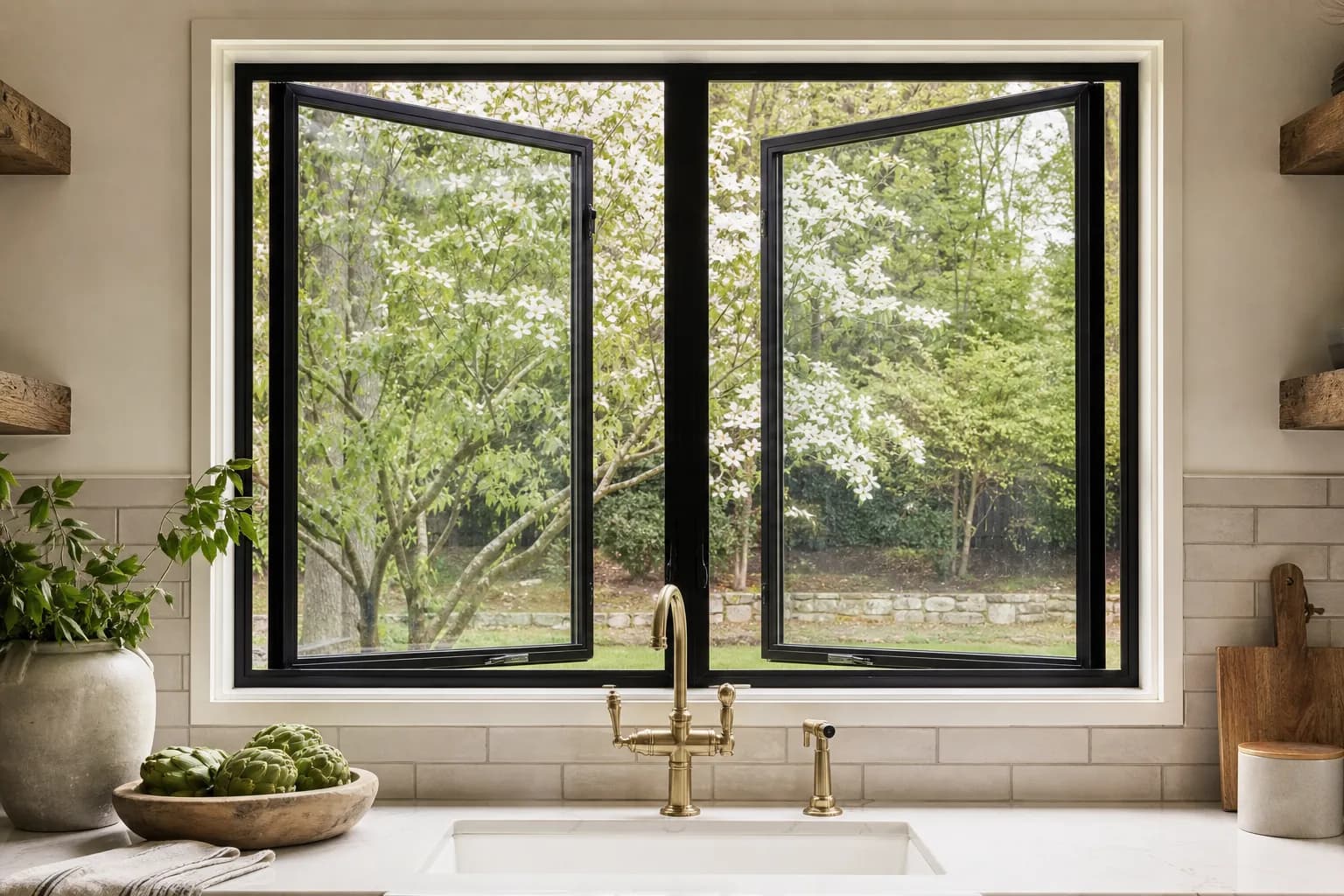
How a casement differs
The sash hinges on one side and swings out on a crank operator. When it closes, the sash presses into a compression gasket all the way around, so casements usually post better air-leakage numbers than sliders and double-hungs. The open sash also acts like a scoop, catching breezes that slide past a flat opening.
Awning windows are the same idea hinged at the top. They can stay open in light rain, which makes them popular in bathrooms and basements.
Where casements earn their place
- Over the kitchen sink or a counter, where reaching up to lift a sash is awkward and a crank is easy.
- Bedrooms that need egress in a modest opening, because the whole sash area opens. See the egress numbers below.
- Beside a fixed picture window, to add ventilation while keeping a wide view. See picture windows.
- On the windward side of a house on a ridge, where the outswing sash catches summer breezes.
Egress in smaller openings
New egress openings under the 2018 IRC need 5.7 sq ft net clear (5.0 at grade), 24 inches clear height, 20 inches clear width and a sill no higher than 44 inches above the floor. A double-hung loses half its height to the fixed sash, so swapping a bedroom double-hung for a casement of similar size can turn a non-compliant opening into one that meets the rule. If you change operating style on a bedroom window, the new unit must meet the size requirements, so confirm the clear-opening dimensions with the installer.
Things to check
- Screens go inside. Since the sash opens outward, the screen sits on the interior. Some owners dislike the look.
- Clearance outside. An outswing sash can hit a porch, deck rail or shrub, and should not open into a walkway at head height.
- Hardware quality. Operators and hinges are the wear parts. Ask whether stainless or coated hardware is included and how replacement parts are sourced.
- Size limits. Very wide casements sag. Large openings are usually split into a pair or a fixed center flanked by casements.
Cost
Fixr's national figures put a casement at $400 to $1,200 installed, compared with $300 to $1,000 for a double-hung. Awning windows run $300 to $800. The crank operator and extra hardware explain most of the gap. National ranges only; see the cost guide for how Knoxville quotes are built.
Back to the main guide: window replacement in Knoxville.